Czech garnet is pyrope, not „garnet in general"
Garnets form a broad mineral group spanning stones from green through orange to deep red. What is called the Czech garnet is pyrope — one particular member of that group, with its characteristic fiery red colour, mined from Czech deposits. The name carries a protected origin, so „garnet jewellery" and „jewellery with Czech garnet" are not the same thing, and they are nowhere near each other in price.
In practice this means the question is not „is this a garnet?" but „is this pyrope from a Czech deposit?". A stone can be a genuine garnet and still not be a Czech garnet.
Why Czech garnets are so small
Size is the most reliable clue. Czech pyropes occur in the deposits as small grains, so cut stones measure only a few millimetres. A stone over a centimetre across being sold as Czech garnet is almost certainly something else — most often imported almandine.
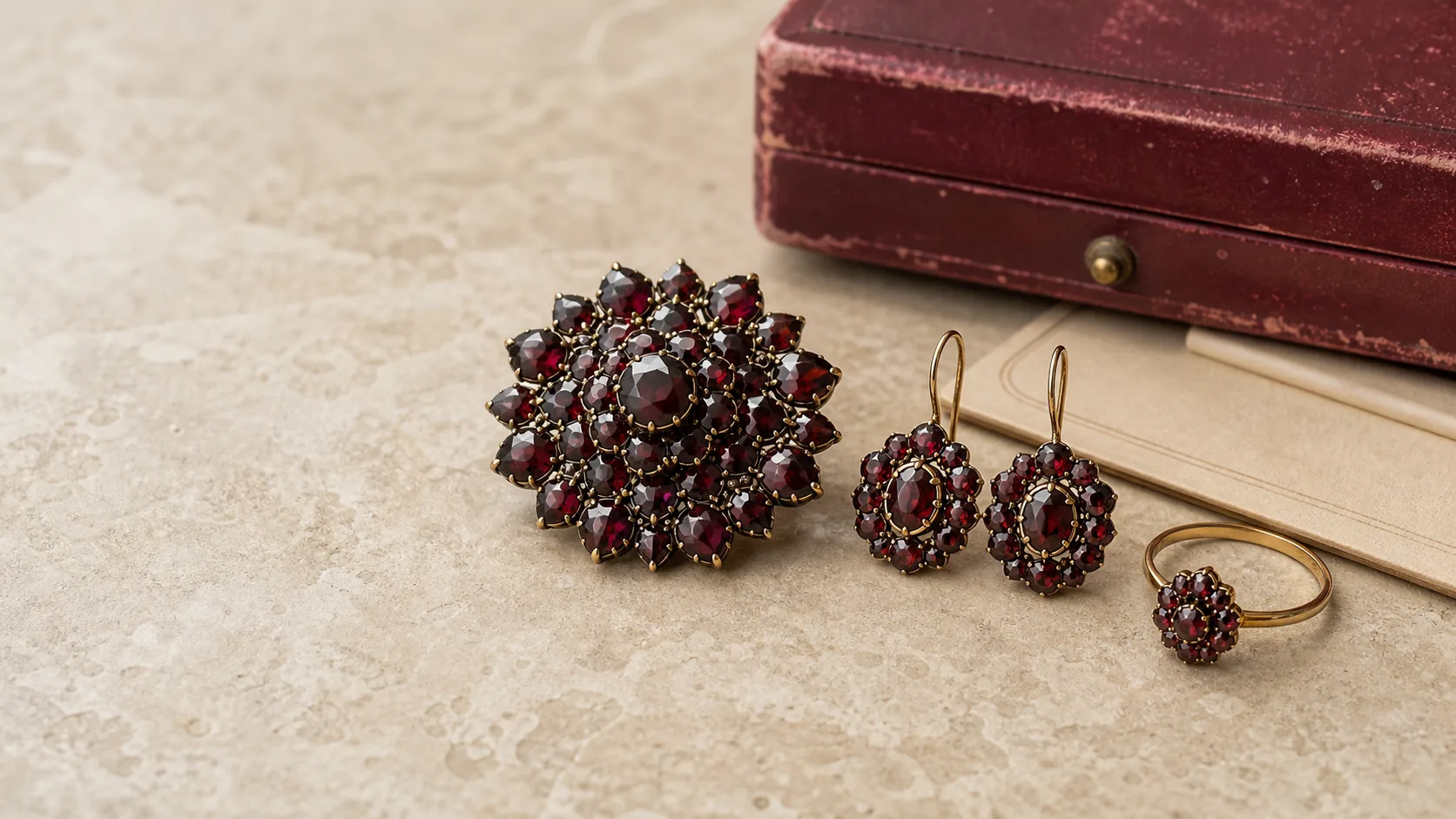
That single property gave rise to the whole style of Czech garnet jewellery. When the stones are small, the only way to achieve a strong effect is to set them tightly side by side. Hence the traditional dense garnet setting, where stones cover the face of a brooch or bracelet almost without a gap and the metal beneath is barely visible.
What Czech garnet is most often confused with
- Almandine. Also a genuine garnet, but darker, tending to purple or brown, and in far larger stones. The commonest imported substitute.
- Red glass. A cheap imitation. It gives itself away through bubbles inside, rounded facet edges, and by warming to the hand faster than a stone does.
- Synthetic spinel and foil-backed glass. On older costume pieces a reflective foil was placed under the stone to fake fire. Under a loupe it shows as a metallic sheen on the underside.
- Rhodolite. A garnet with a pinkish-purple cast — a handsome stone, but a different colour altogether.
Two tests you can run at home
Light. Hold the stone against a light source. True pyrope glows a deep fiery red right through, its colour alive even in a small stone. Almandine stays dark and brownish; glass, by contrast, looks suspiciously clean and uniform.
A strong magnet. Garnets contain iron and magnesium and therefore respond to a neodymium magnet — a loose stone on a light support is visibly drawn to it. Glass does not respond at all. This test reliably separates garnet from glass, but it will not distinguish Czech pyrope from imported almandine; both are garnets. On a set piece the metal also affects the response, so it is only meaningful with loose stones.
What determines the value of garnet jewellery
Unlike a diamond, garnet jewellery is not valued by the carat weight of the stone. What counts is the piece as a whole — the number and quality of stones, the metal, the craftsmanship, age and completeness.
| Type of piece | What decides | Indicative value |
|---|---|---|
| Antique gold jewellery with garnets | gold + garnets + workmanship | higher, by stone count |
| Silver jewellery with garnets | silver + garnets | medium |
| Loose cut garnets | size, colour, clarity | by stone quality |
On antique pieces from the nineteenth and early twentieth century — brooches, bracelets, complete parures — the value sits well above the metal alone. What drives it is the collectable and artistic dimension, and that disappears the moment a piece is taken apart. Garnet jewellery is therefore never worth splitting into metal and stones.
Missing stones are not a disaster
Old parures are often missing a stone or two. That does not mean the piece has lost its value — replacing them is routine restoration work. What genuinely does reduce value is an attempt to prise out the remaining stones or to „clean" the piece with abrasive polish. Garnet is reasonably hard, but its seats and prongs in old metal will not take rough handling.
Certificate and trademark
On new jewellery, authenticity is evidenced by a certificate and trademark that only authorised makers may use. On inherited and antique pieces no such documentation usually exists, and authenticity is assessed professionally — from the stones, the cut, the construction of the settings and the marks on the metal.
Free, non-binding valuation
We value garnet jewellery free of charge with no obligation to sell. Bring it to Kotlářská 28, Brno-střed or send photos through the no-obligation buying enquiry. How the valuation runs step by step is described in The Czech garnet valuation process; details of the service are on the Czech garnet buying Brno page.