What to bring, and what to leave well alone
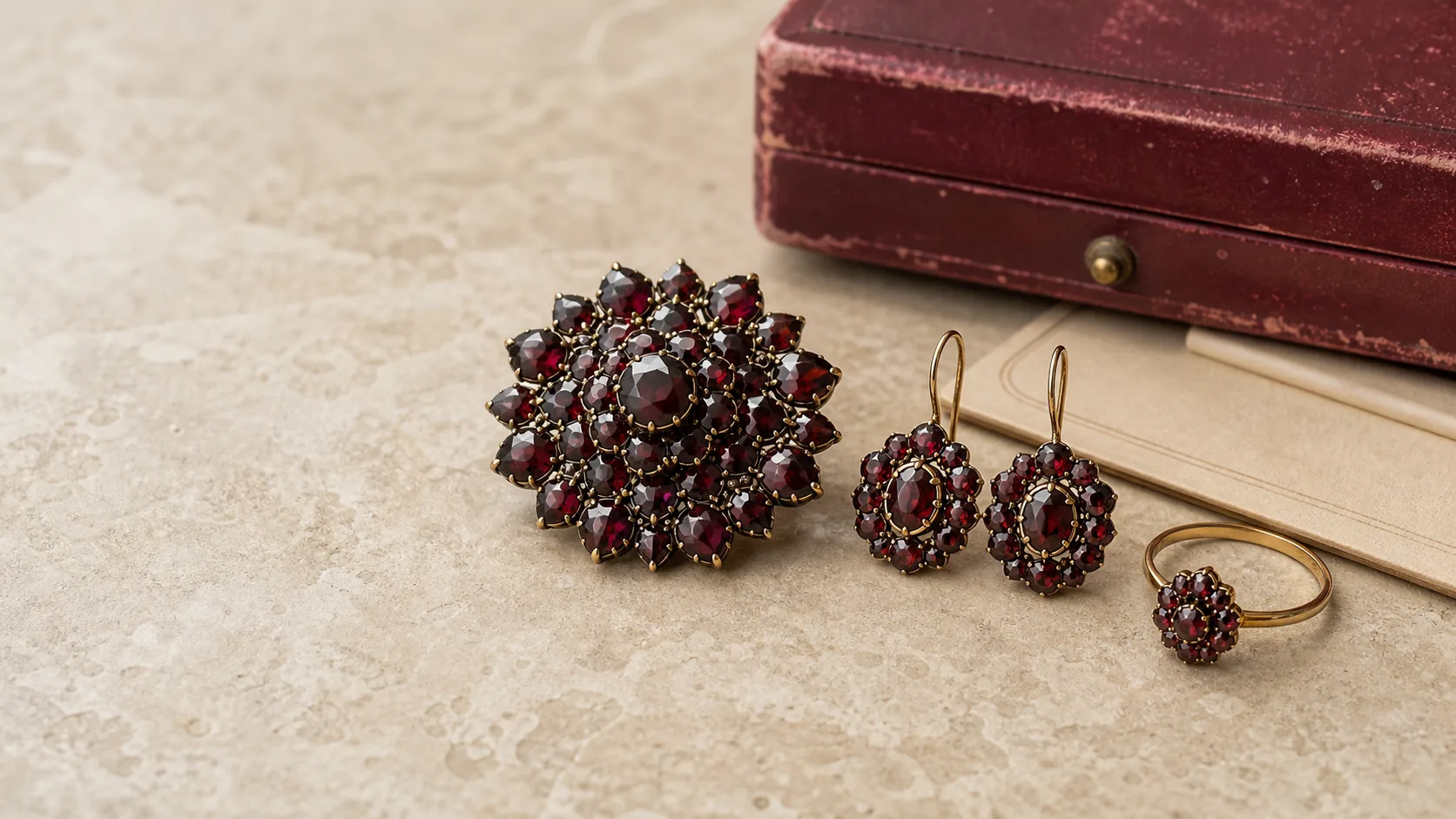
Bring the piece as it is: in its original box, with any certificate, receipt or family papers that survive. For a parure, bring every part at once — brooch, earrings and bracelet are assessed as a whole and would be worth less separately.
Conversely, three things not to do: do not dismantle the piece, do not remove stones, and do not polish it with abrasive products. A missing certificate does not make a piece worthless — antique jewellery is judged on material, construction, marks and the properties of the stones, not on paperwork.
Stage 1: the piece as a whole
Assessment starts with the whole, not the detail. Proportions, style, setting technique and completeness all get looked at. With garnet jewellery this carries more weight than in other categories: the traditional dense setting of small stones, an original clasp and an intact parure can mean more to the market than the same stones removed from their construction.
This stage also reveals whether a piece has been reworked — a brooch converted into a pendant, for instance. That is not a defect, but it is information that belongs in the valuation.
Stage 2: metal and marks
Garnet jewellery was made in gold, silver, tombac and other alloys, so the material of each part is identified first and assay, fineness and maker's marks are sought. For gold and silver, the purity and the countable metal weight are established. For tombac, value rests mainly on the stones, age and state of preservation — a tombac piece is by no means automatically worthless.
A maker's mark helps place origin and period. Granát Turnov, for example, guarantees the authenticity of the garnets in its own production through a certificate and the maker's mark „G"; the details are set out in the official Granát Turnov information. Other and older pieces have their origin assessed independently.
Stage 3: the stones, and why each is described separately
For the stones, what counts is colour, transparency, size, cut, number, consistency across a parure, and how they are set. At the same time we look for cracks, abrasion, and stones that are loose or were replaced at some point.
One detail matters a great deal: historical garnet jewellery often combines several kinds of stone. A larger centre stone is frequently set among small pyropes, and it may be almandine or something else entirely. Each component is therefore described separately and nothing is labelled Czech garnet wholesale. How pyrope differs from other garnets is covered in Czech garnet: price and authenticity.
Stage 4: age, style and quality of work
On an antique piece, the period, the quality of the handwork, the originality of the construction and any identifiable maker are all weighed. Art Nouveau, Art Deco or First Republic pieces may be valued as a collectable whole, whereas newer mass-produced work rests more on material, condition and current demand.
A repair in itself is not a problem. A sensitively replaced clasp is practical and bothers nobody. Crude soldering, unsuitably replaced stones or a rebuild of the original construction do reduce collector value — and that cannot be undone.
What the final offer is made of
The final figure can combine several elements at once:
- the value of gold or silver by purity and countable weight,
- the quality, number and condition of the stones,
- maker, age, workmanship and collector demand,
- completeness and the cost of any repair,
- saleability of the piece as an intact whole.
On good antique or marked jewellery the offer therefore should not be phrased as „metal price per gram". Ask whether the whole or the individual materials are being valued, and what influenced the offer most. For ordinary scrap gold the mechanism is different and is described in How the gold buying price is calculated.
When it takes longer than one visit
A single ordinary piece we assess provisionally within one visit. More time is needed for a substantial estate, an unusual antique, or a piece whose stones require further verification. In those cases we agree the scope and terms of the assessment in advance — and before you leave anything with us, it must be clear what will happen to it.
If you decline the offer
The valuation is non-binding, so declining is a perfectly ordinary way for a visit to end. You get the jewellery back in the condition you brought it in — which is why no destructive test is used on garnet pieces without your explicit agreement. You take the finding on purity and condition away with you and can use it anywhere else.
To have your jewellery assessed, come to Kotlářská 28, Brno-střed. Valuation and buying of Czech garnets is non-binding; how to prepare jewellery beforehand is summarised in Prepare jewellery for valuation.