A pearl is not a stone
This is the fundamental difference from everything else used in jewellery. Diamond and gold do not change over time, but a pearl is organic material — layers of nacre bound by organic matter. It dries out, reacts to cosmetics, and after long dry storage the nacre can craze and crack.
From which follows advice that sounds paradoxical: pearls benefit from being worn. The moisture of the skin suits them better than decades in a safe. A grandmother's necklace that nobody has taken out since the 1970s may be dull with a compromised surface — and that shows up in the valuation.
Natural, cultured and imitation
- Natural pearls formed without human involvement and are now very rare. In practice you meet them only in antique jewellery predating the 1920s.
- Cultured pearls make up the overwhelming majority of the market. The nacre is entirely genuine; only the stimulus to form it came from a farmer. They are not imitations.
- Imitations are glass or plastic with a sprayed-on pearlescent coating.
Natural and cultured pearls cannot be told apart by eye — the difference is internal, in the structure of the core, and on valuable pieces it is determined by X-ray in a laboratory. The difference in price, meanwhile, is substantial.
Being straight about resale value
This is worth saying plainly: an ordinary cultured pearl necklace usually fetches less than its owner expects. Cultured pearls are produced at scale and demand for second-hand strands is limited. Higher values attach mainly to natural pearls, large fine individual pearls, signed pieces, and necklaces with a valuable clasp.
That does not make an assessment pointless — quite the opposite, since spotting a natural pearl among cultured ones is exactly where it pays off. It is simply worth arriving without an unrealistic expectation.
Checking at home without risk
The most widely circulated tip — rubbing a pearl against your teeth and feeling for grittiness — does work, but it abrades the surface and, on a strung necklace, the stringing too. We advise against it. Safe alternatives:
- A loupe on the drill hole. On imitations there is often a flaking or sharply cut coating visible around the hole. Genuine nacre runs smoothly into the drill hole.
- Gently rubbing two pearls together. Real pearls have a minutely irregular surface and catch very slightly. Imitations slide against each other. The lightest touch is enough.
- Looking against the light. Real pearls on one strand are never quite identical — small differences in shape, tone and lustre indicate authenticity. Perfect uniformity is suspect.
- Temperature. A real pearl feels cool at first touch and warms in the hand more slowly than plastic.
What determines price
- Lustre. The most important factor. A fine pearl reflects light sharply and reads as deep rather than milky.
- Surface. Small irregularities are natural and unobjectionable. Cracked nacre, worn patches and pronounced blemishes push the price down.
- Shape. Perfectly round pearls are more sought after, though good baroque shapes carry value of their own.
- Size. Larger is rarer — but only where the rest of the quality is comparable.
- Colour and overtone. Both the body colour and the fine iridescent sheen are assessed.
- Matching. On a necklace, how uniformly the pearls read as a set matters.
The clasp is often worth more than you think
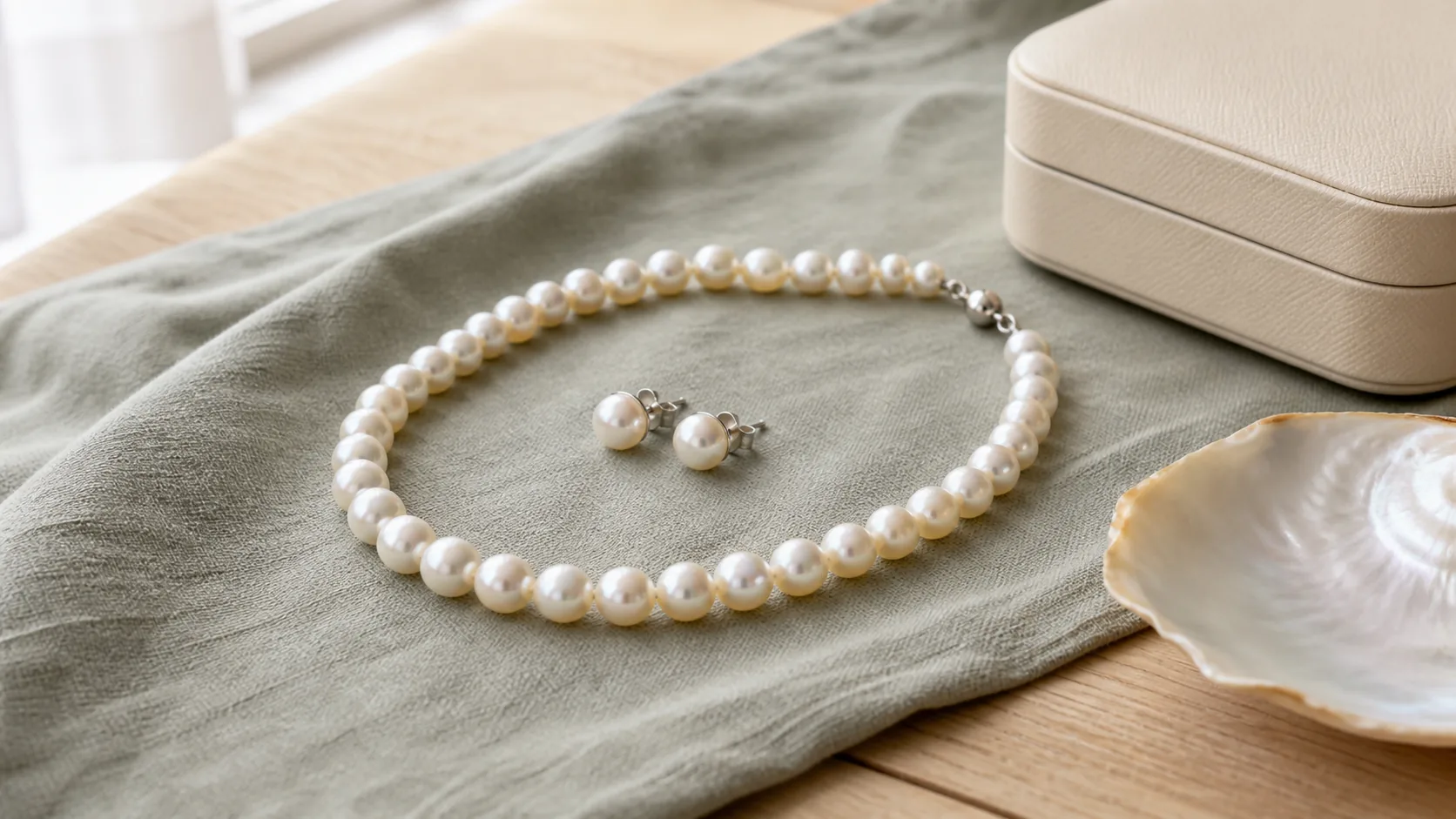
On pearl necklaces the clasp is valued in its own right; it is frequently gold or platinum and sometimes diamond-set. On older pieces it is not unusual for the clasp to be worth more than the strand itself. So bring the piece complete, even if the thread has broken.
Do not restring, do not clean
Do not clean pearls chemically before a valuation — ultrasonic baths, alcohol and jewellery cleaners are unsuitable and can damage nacre permanently. Equally, do not have the strand restrung; restringing is ordinary maintenance, but you will not recover the cost ahead of a sale. Bring loose and fallen pearls along, a small bag is fine.
Further practical guidance is in Prepare jewellery for valuation.
Valuation in Brno
We assess pearl necklaces, bracelets, earrings and rings at Kotlářská 28, Brno-střed — individually or as part of an estate. During a jewellery valuation we consider the pearls, the metal, the clasp, any stones and the overall execution. The valuation is free and non-binding.