A home test excludes, it does not confirm
Starting here saves disappointment. No procedure you can run at the kitchen table will tell you „this is genuine 585 gold". It can, however, reliably tell you the opposite — that a piece behaves in a way gold should not. The point of a home check is therefore not a verdict but a sort: what is obviously problematic, and what is worth having measured.
First: five minutes of preparation
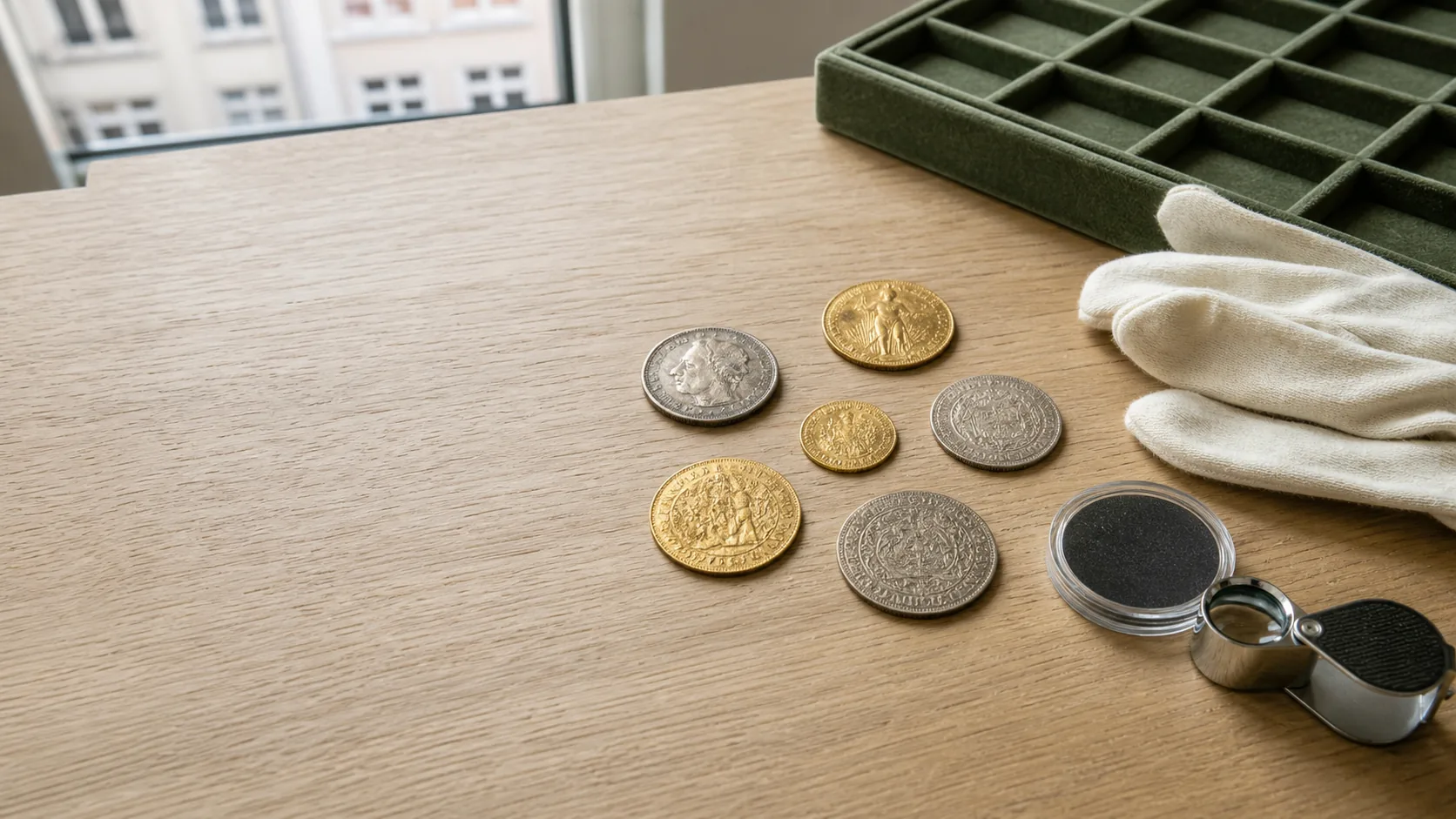
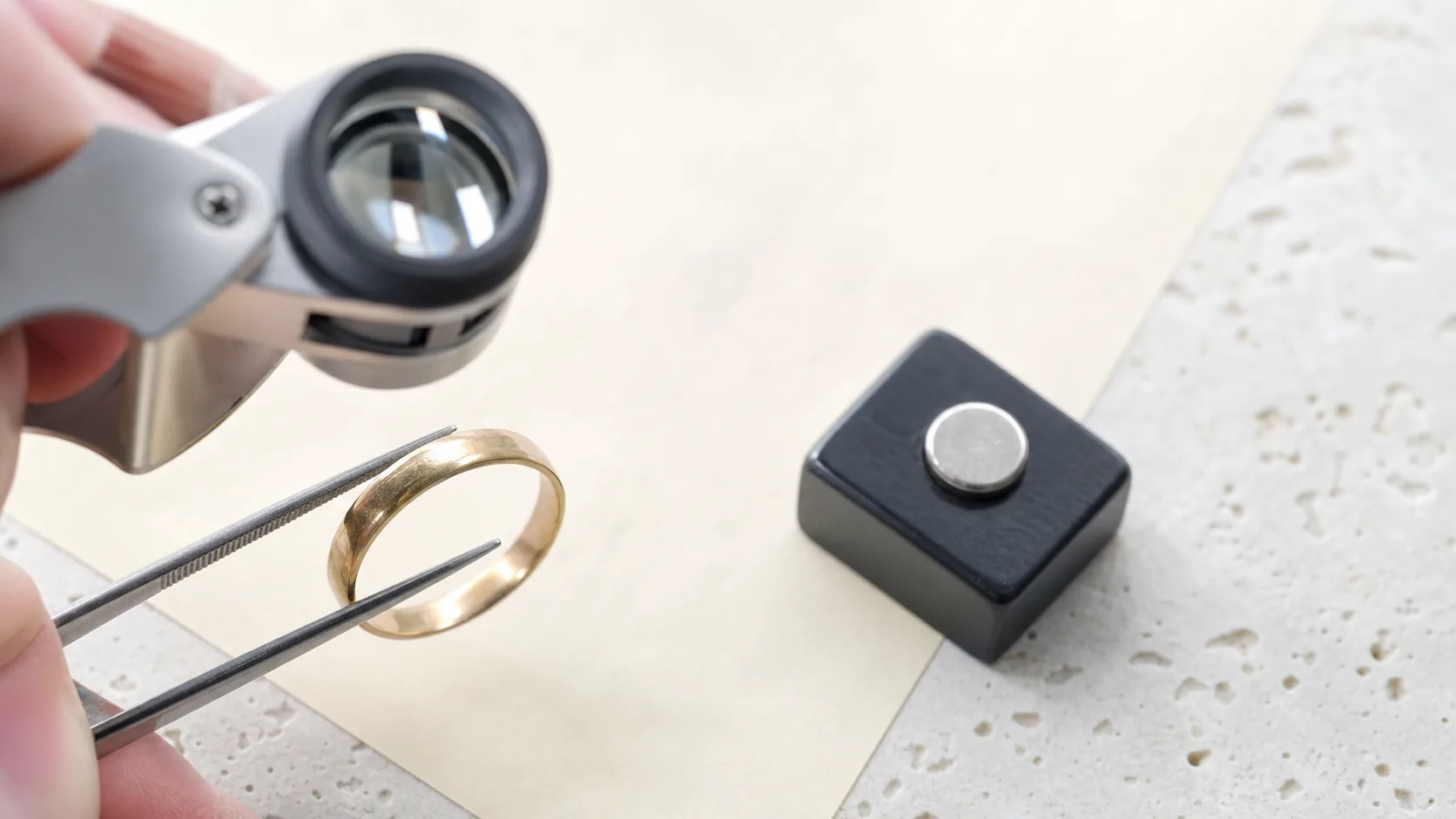
You need a window with daylight, a loupe or a phone with a macro mode, a soft cloth and one reasonably strong magnet — the fridge magnet or the one from an old pair of headphones will do. Spread a towel on the table so a small piece does not end up on the tiles. And one rule up front: if the piece has a wobbling stone, a crack or delicate antique construction, do not test it at all — have it assessed straight away. Damage from careless handling usually costs more than the price difference you set out to verify.
The hallmark says less than you expect
The number 585 stamped inside a band does not mean the piece is 585 gold. It means somebody claims it is. A fineness number can be struck onto anything, and on imported costume jewellery you will meet it routinely. What actually carries weight is the state assay mark, which has a prescribed shape and sits beside the fineness number as a separate punch — you can compare the shapes in the Czech Assay Office overview.
The opposite trap applies too: a missing hallmark is not proof of a fake. It disappears when a ring is resized, on small earrings it was often never struck at all, and pieces inherited from a grandmother carry Czechoslovak marks that look nothing like the current pattern. The hallmark is a clue, not a ruling — in both directions.
Where plating gives itself away
A plated piece does not betray itself on a polished face but where it rubs hardest. Four places deserve the loupe:
- The inside of a ring, at the bottom of the band where it chafes against the finger.
- Edges and corners of pendants and lockets.
- Jump rings and chain links, which abrade against each other.
- The clasp, which the hand touches most often.
You are looking for reddish copper showing through, greyish brass, or a spot where the gold tone ends in a hard edge. Flaking is another warning sign. Conversely, a slightly yellowish cast on white gold is not a fault — the rhodium plating has simply worn through, which happens to expensive and entirely genuine pieces too.
The magnet: the one test with an unambiguous result
Gold is not ferromagnetic, without exception. If a whole piece clings readily to a magnet, it contains iron or steel and is certainly not solid gold. That is a clear and useful finding.
Two caveats belong with it. First, a weak response at the clasp alone means nothing — there is a steel spring inside a lobster clasp, including on an honest gold chain. Second, and this matters more: no response proves nothing whatsoever. Brass, copper, aluminium and silver are all non-magnetic, so the overwhelming majority of fakes sail through. The magnet weeds out the crudest, no more.
Density: when it helps and when it misleads
Gold is remarkably dense — a compact gold object feels heavy for its size. This guide works soundly on a simple solid bar with no stones and no cavities, whose density you can even measure at home by immersion in water.
On jewellery, do not rely on the result. A hollow bangle, a ring with a stone, or a piece assembled from several materials will read completely out of range with nothing whatever wrong with it. Immersion can also damage glued stones and sensitive finishes — with antique pieces, skip it entirely.
Tests that leave the piece worse off
Plenty of „proven" methods circulate online, and they share one trait: they damage your piece and still give no certainty.
- File and ceramic tile — they leave a groove nobody can close again, and the value drops with it.
- Acids — can etch the metal, dissolve solder and damage stones. Professional touchstone testing looks simple but needs reference samples and practice.
- Vinegar and bleach — unreliable, and no favour to the surface.
- Heat and open flame — melt soldered joints and ruin most stones irreversibly.
- Biting it — proves nothing and costs you enamel.
When to stop
The moment the findings contradict each other — the hallmark checks out but copper shows at the edge — stop testing. Instrument measurement in the shop takes seconds, leaves no trace on the piece and answers a question you cannot settle at home. On pieces with stones we also separate metal value from setting value, which a home test cannot do by its very nature.
Bring the piece to Kotlářská 28, Brno-střed — we check authenticity and purity free of charge as part of a no-obligation gold valuation. The individual home tests and their limits are covered in more depth in How to recognise real gold.