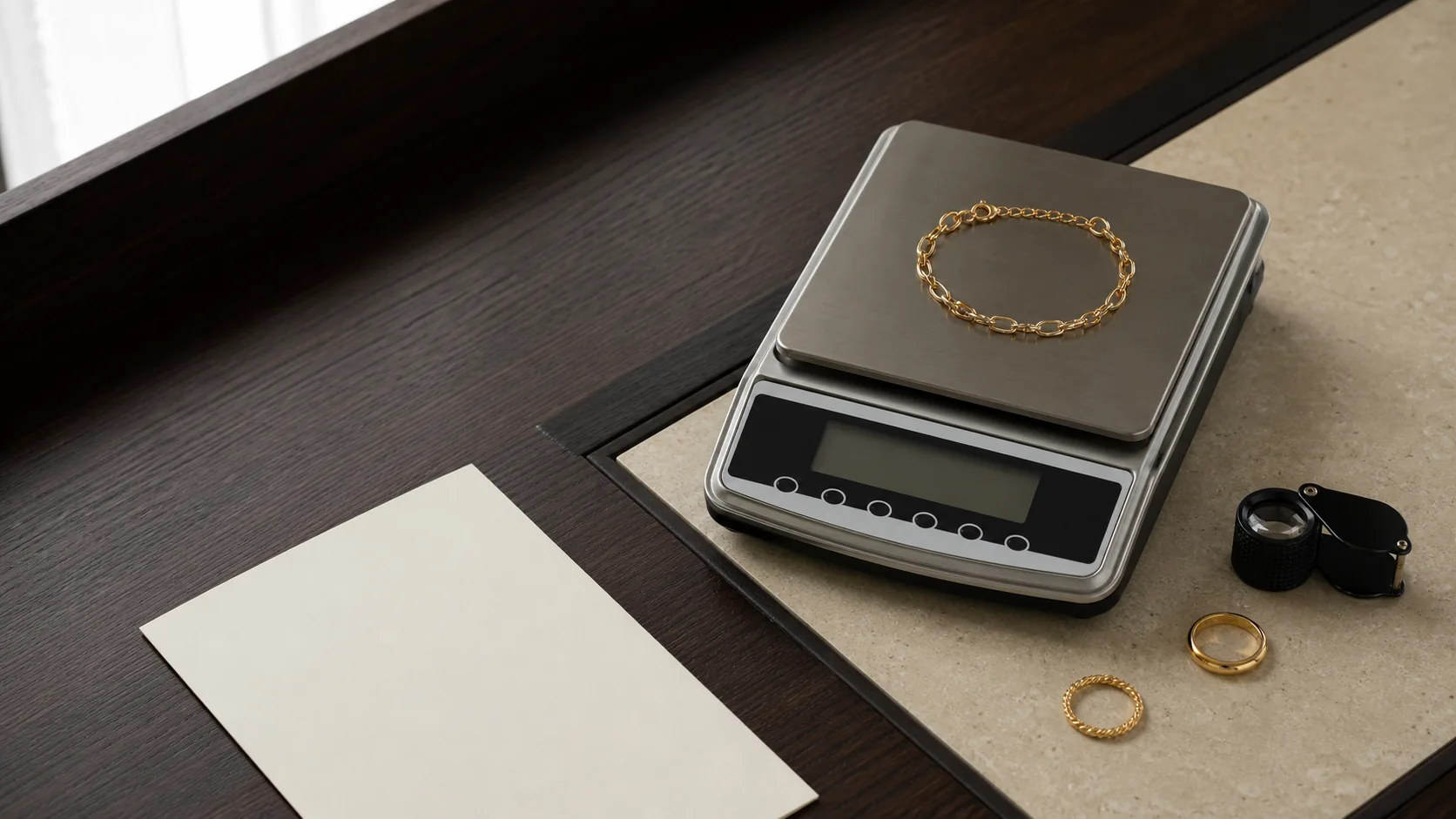
Four things that look like gold
Before you start testing, it helps to know what you are actually looking for. Pieces people bring in asking „is this gold?" fall almost always into one of four categories — and each behaves differently.
- Electroplating. A gold layer a few microns thick deposited on brass or silver. The most common, and the quickest to wear through.
- Rolled gold (gold filled). A thicker gold layer mechanically bonded onto a core. It lasts decades and is indistinguishable at a glance.
- Vermeil. Gold-plated silver. A 925 hallmark on a gold-coloured piece is not a swindle — the piece really is silver, it just looks gold.
- Tombac and brass. Copper-zinc alloys with a naturally golden tone and no gold in them at all.
How each one gives itself away
Plating wears through at edges and friction points — first on the underside of a ring and at the clasp. Reddish copper or greyish brass shows underneath, and the transition has a hard edge.
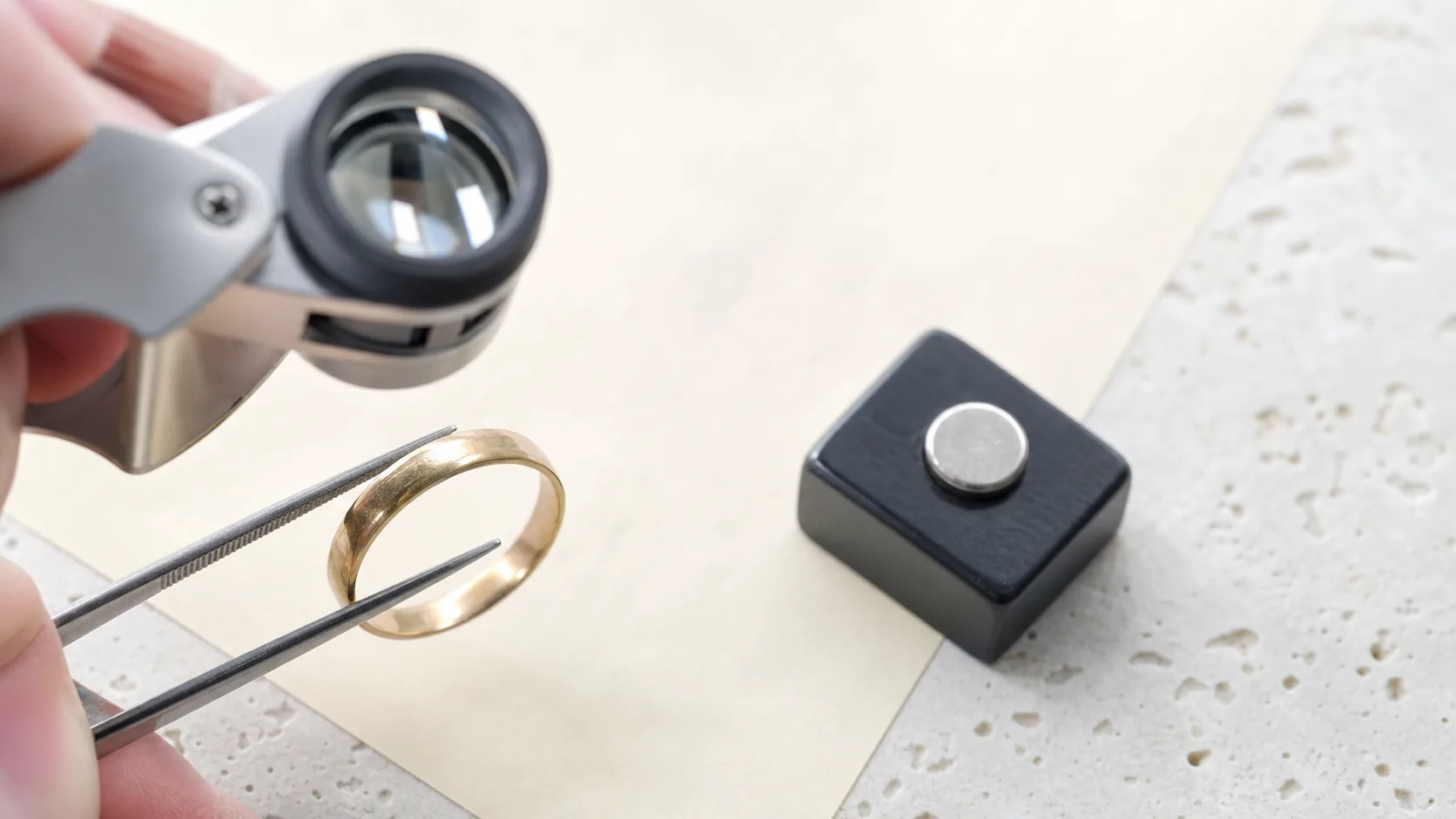
Rolled gold is trickier because the layer survives. A loupe on the joints and the inner face helps — bonded sheet sometimes shows a fine seam where it was folded. The marking differs from a fineness number: look for „1/20 12K GF" or „doublé".
Vermeil is identified by a 925 hallmark or an „Ag" mark — and it behaves like silver, tarnishing black over time wherever the plating has worn away.
Brass and tombac carry no hallmark at all, are noticeably lighter, and after a while in the hand start to smell distinctly metallic. Gold and silver have no smell.
When jewellery stains the skin
A green band on the finger is probably the most common reason people start doubting a piece. On its own, though, it does not mean the piece is not gold. The green mark comes from copper reacting with sweat and cosmetics, and copper is a normal alloying metal in honest 585 gold too — just in a smaller proportion. The staining therefore points to lower purity or worn-through plating rather than to a fake.
A black mark is a different story: that indicates silver oxidising. On a piece you believed to be gold, it typically means vermeil.
Colour hints at purity, not authenticity
The higher the purity, the deeper and warmer the yellow. Nine carat gold (375) looks pale, almost sallow; fourteen carat (585) has the classic gold tone most people picture; eighteen carat (750) is markedly richer, verging on orange. Pure 999 gold shows a deep, soft yellow and is soft enough to dent with a fingernail — which is why jewellery is essentially never made from it.
This comparison only works with pieces side by side, though. A single ring in your palm will not reveal its purity, and even an experienced goldsmith cannot reliably separate 585 from 750 by eye.
Why you cannot establish a specific purity at home
Every home method shares the same ceiling: it can separate „metal that behaves like gold" from „metal that does not". It cannot tell you whether an alloy is 585 or 750 — and on a ten-gram piece that distinction is worth several thousand crowns. Purity is a property that has to be measured, not estimated.
The instrument in the shop reads the composition in seconds without a single scratch. A practical routine for examining a piece at home before you take it anywhere is in How to test gold at home safely.
What comes next
If your home check suggests the piece probably is gold, the next question is usually „and what will I get for it". The answer depends on purity and weight — the detail is in Gold buying in Brno: price per gram.
We measure purity free of charge at Kotlářská 28, Brno-střed, even if you end up selling nothing. An overview of Czech marks is on the Czech hallmarks page.