A ring is not one piece of metal
This is the key to the whole check. A typical ring with a stone consists of the shank, the head holding the stone, the prongs, the soldered joints and, on resized pieces, an inserted section at the bottom. Each of these parts may have been made at a different time, in a different place, from a different alloy.
Which is why „is this ring gold?" misleads as a yes-or-no question. An honest gold ring can carry an insert of lower-purity metal, just as a plated ring can carry a genuine hallmark on one soldered-on tag. Each part is assessed separately.
Where a ring most often fails to match
- The bottom of the shank. It rubs hardest against the finger and neighbouring rings. This is exactly where plating wears through and copper or brass shows underneath.
- The insert after resizing. A goldsmith adds it when changing the size, and it need not be the same alloy. A colour difference at the bottom is usually this — not a fake but a repair.
- The prongs. Small and heavily stressed. On plated pieces the gold goes here first.
- The head-to-shank joint. A hard colour transition or visible solder in a different tone.
- Inside the shank at the hallmark. If the marking is struck on a separate tag soldered inside, take note — the hallmark then belongs to that tag, not to the ring.
Falsely hallmarked goods do exist
The Czech Assay Office repeatedly warns that falsely hallmarked gold goods reach the market, with marks a layperson cannot distinguish from genuine ones. A fineness number such as 585 or 750 can be struck by anyone with a punch costing a few hundred crowns. The state assay mark, by contrast, has a prescribed shape, symbol and fineness-class number — photograph it in macro mode and compare it against the overview of valid marks.
The reverse also holds: a missing or illegible hallmark proves nothing on its own. On small and old rings the mark is worn away by use, and some categories of goods were never subject to hallmarking at all.
Where fake rings usually come from
Experience at the counter shows a few recurring situations:
- A listing with no paperwork. A price well below the value of the gold claimed, a seller in a hurry who refuses to meet at a shop. An honest sale gives no reason for any of that.
- A holiday souvenir. Rings bought at markets in coastal resorts are frequently rolled gold or tombac, carrying a hallmark matching no European standard.
- „Grandmother's inheritance". Often it is honest costume jewellery from the first half of the twentieth century that nobody in the family ever tested. It is not a swindle — nobody simply ever looked.
- A ring after repair. The piece is genuine, but the insert or a replacement head is of a different purity, so the resulting average falls below what the hallmark promises.
What not to do at home
- Do not scratch it against unglazed ceramic or file into the shank — nobody can close that groove.
- Do not apply acids or bleach directly to the piece.
- Do not heat it with a lighter; the solder and the stone may not survive.
- Do not prise out the stone to weigh it, and do not dismantle old hallmarked pieces.
If you have already bought the ring
If a ring you bought turns out not to match its description, what matters is having something to evidence. Keep the listing or product description, proof of payment and your correspondence with the seller. Buying from a trader gives you statutory rights for defective goods; between private individuals enforcement is harder, but a record of what was promised is the foundation.
Before any further step, get the actual state documented in writing — the measured purity and the weight. Without that it stays one person's word against another's.
How to get certainty
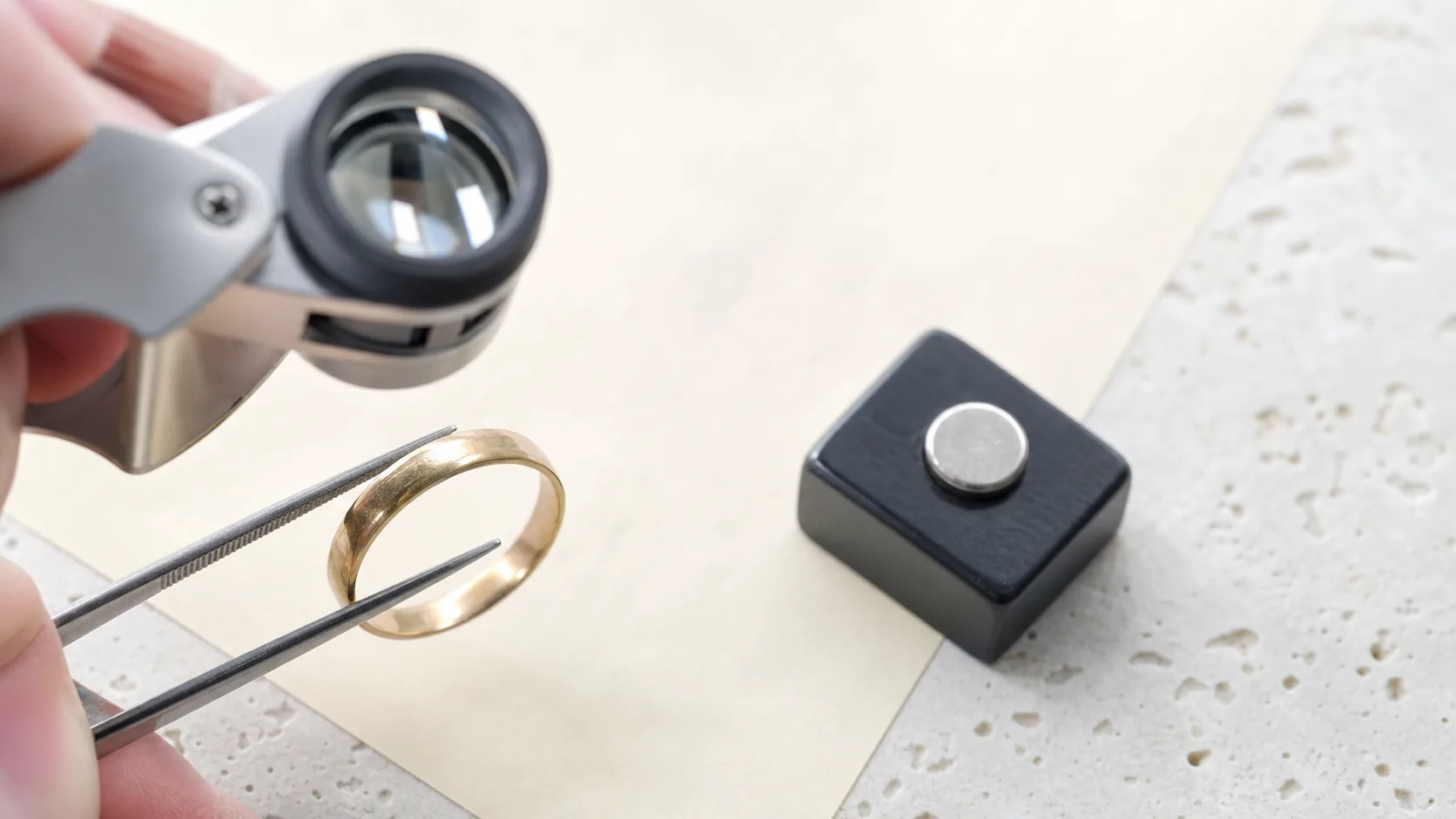
A specialist assesses construction, marking and surface first, and only then selects a metal-testing method — on a ring the shank and head are measured separately, because they can differ. On more valuable pieces, the stone, the maker's mark and any antique value are assessed in their own right.
Bring the ring to Kotlářská 28, Brno-střed and have it checked during a free gold valuation. How to examine the piece at home beforehand is summarised in How to test gold at home safely.