Why the buying price is below the purchase price
Worth knowing in advance so the offer does not come as a shock. The price you paid at the jeweller's covered not only the stone and the metal but also the retailer's margin, running costs, design and VAT. None of those come back on resale — they were spent the moment the ring left the display case.
With jewellery the same holds as with cars: the gap between retail and buying price is the rule, not a sign of sharp practice. You cannot therefore judge an offer by comparing it against the original receipt — judge it by whether the buyer itemises how much falls to the stone and how much to the metal.
The question that now comes first: natural or lab-grown?
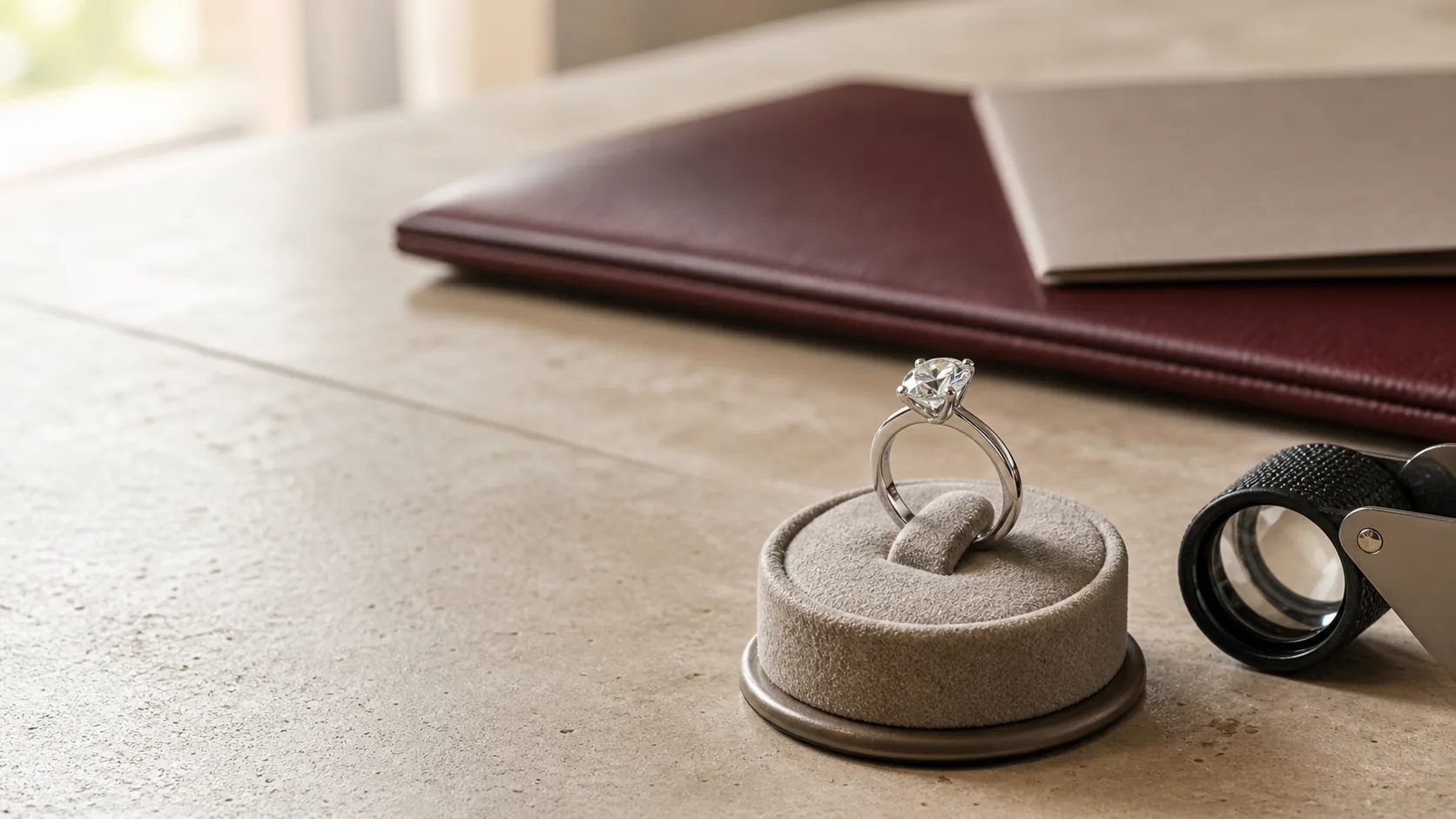
Ten years ago this did not arise. Today it comes first. Lab-grown diamonds are chemically and optically real diamonds — not an imitation like cubic zirconia or moissanite. They have the same hardness, the same brilliance, and neither the naked eye nor an ordinary loupe will separate them from natural stones.
The difference is in price. Production of lab-grown stones has become cheap quickly, and their resale value sits substantially below that of a comparable natural stone. For anyone who bought a ring in recent years this is essential — and unfortunately often surprising — information, because the seller was under no obligation to stress it.
Telling the two apart requires spectroscopic instruments, not an ordinary diamond tester (which distinguishes diamond from moissanite but says nothing about origin). If you have a certificate, the origin is usually stated on it; without documentation the stone needs screening.
The 4Cs, and which carries the most weight
The international grading standard rests on four parameters:
- Carat (weight) — stated in carats. Price does not rise linearly, though: a one-carat stone costs considerably more than two half-carat stones together, because large stones are rarer.
- Cut — proportions, symmetry and polish. For both appearance and price this is the most important of the four: a poorly cut stone looks lifeless no matter how clean it is.
- Colour — on colourless stones the degree of yellow tint is graded; on fancy coloured stones, the intensity instead.
- Clarity — internal inclusions and surface features visible at ten times magnification. Fine inclusions you cannot see with the eye affect price less than most people expect.
Price cannot be established from a photograph or the diameter of the stone. Two stones of identical size can differ severalfold.
A GIA, IGI or HRD certificate
A certificate from a recognised laboratory describes the parameters of that specific stone and speeds a valuation up considerably — not least because it settles the question of natural origin. A ring can be valued without one; the assessment simply takes longer and errs on the cautious side in borderline cases.
Bring the original box, the receipt and any documentation too. On older rings, whatever you know about the provenance also helps — when and where it was acquired.
Metal, setting and antique value
After the stone comes the metal. Diamond rings are usually gold 585 or 750, but also platinum, identifiable by a 950 or Pt mark and noticeably heavier. We check the purity and weigh the ring; indicative metal prices are in the price list.
On antique and signed rings a third element enters — period, maker, originality and condition. There the offer need not be the sum of stone and metal but the value of the whole; more on that in How to identify valuable antique jewellery.
How to go about it
- Leave the ring as it is — do not prise the stone out of its setting at home. Damaged prongs cost more in value than the time saved is worth.
- Bring every certificate and document you have for the piece.
- Insist that the valuation happens in front of you and covers stone and metal separately.
- Confirm in advance that the valuation is non-binding and carries no hidden fee.
- Decide with the itemised offer in hand, not under pressure.
Valuation in Brno
We value diamond rings and other jewellery with mounted stones at Kotlářská 28, Brno-střed. We do not buy loose or standalone stones. We test the stone in the jewellery, grade it against the 4Cs, and account for the metal and any antique value separately. Diamond jewellery valuation is free and non-binding.